A prerequisite to assessment of diastolic LV function is the capability of the method to measure
pressures, and Doppler echocardiography is only able to measure velocities. Only through
application of formulas, as the modified Bernoulli equation (V² · 4 = ΔP)
it is possible to estimate pressure gradients.
Different alternative possibilities to assess diastolic LV function were developed in the last decades.
However, these tools made diagnosis of global diastolic LV dysfunction not always easy and clear.
Sometimes different parameters just do not match to each other, or can not be correctly interpreted in case
of atrial fibrillation or flutter.
A new equation enables non-invasive assessment of PCWP, the Nagueh-Formula:
1,9 + (1,24 · E/E') = PCWP, that could make estimation of diastolic function in some way
easier, since PCPW ≈ mLAP ≈ LVEDP.
Here an
online
calculator from the Canadian Society of Echocardiography, to calculate PCWP.
Classic parameters are still in current use and will be presented below. Current
guidelines
of the American Society of Echocardiography concerning diastolic function can be found here.
Mitral inflow velocities examination
Pulsed wave Doppler (PW-Doppler) allows the measurement of velocities at the level of
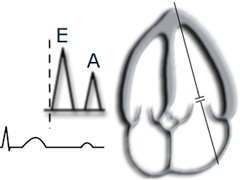
the sample volume. Two flow velocity envelopes can be seen during diastole in
persons with sinus rhythm: the E-wave, representing the early, passive filling of the
left ventricle, and the A-wave, that happens late in diastole, representing the
active filling, the atrial contraction.
Left: PW-Doppler sample volume is placed
at the tips of the mitral valve in the left ventricle.
Right:
normal mitral velocities, inflow coming from
the left atrium in the left ventricle during diastole, shown here with color Doppler.
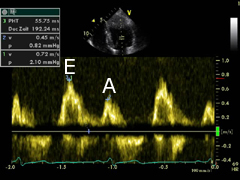
Left: pulsed wave (PW) Doppler spectral display
shows an E-wave with higher velocities, as well as an end-diatolic A-wave with lower velocities.
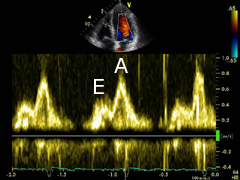
Right:
an A-wave twice as large as the E-wave
indicates impaired LV relaxation.
Slow wall velocities can be assessed with Tissue Doppler Imaging (TDI). The sample volume,
when placed at the medial mitral annulus, shows slower velocities as when placed at
the lateral annulus. The E/E' relationship will be different according to each case,
making more difficult the interpretation of results.
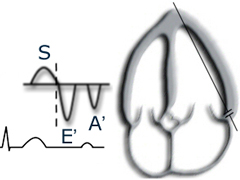
Left: PW-TDI sample volume is place at the level of the
lateral mitral annulus.
Right: normal LV wall velocities during cardiac cycle,
here a color coded display.
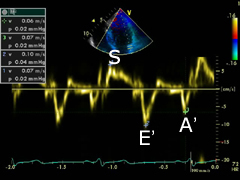
Left: spectral tissue Doppler (TDI) display shows an antegrade sys- tolic,
and two retrograde waves, E' (passive LV filling) and A'-wave (atrial contraction).
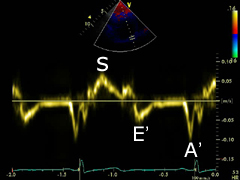
Right:
E' and A' waves show here a reversed relationship. In com- bination with other parameters this could
indicate an impairment of relaxation or a pseudonormal pattern.
Pulmonary venous flow velocities can be assessed with PW-Doppler. Localization of
pulmonary veins with color Doppler is relatively easy, and allows to place sample
volume at the right position.
Usefulness of the examination of pulmonary venous for estimation of left atrial
pressure was shown by
Kuecherer H et al. Circulation 1990;82:1127-1139.
Left:
pulmonary venous flow can be assessed with PW-Doppler from the apical four-chamber view.
Right:
normal pulmonary vein velocities into the left atrium during
cardiac cycle, here shown with color Doppler.
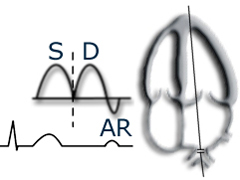
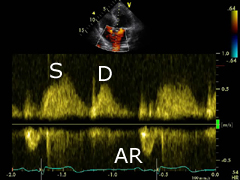
Left:
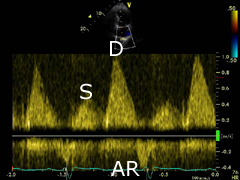
PW Doppler spectral display shows a larger systolic (S), a diastolic (D) and
a smaller end- diastolic wave (AR), the atrial contraction.
Right:
the shift towards diastole, with a predominant diastolic wave (D) speak for
an increase of LA pressure. This can be documented in a case of impairment
of LV compliance (restrictive pattern).
Velocity of flow progression (Vp) during diastole can be assessed with color Doppler M-mode.
A Vp > 50 cm/s can be considered as normal. A E/Vp ≥ 2.5 in a patient with impaired
systolic left ventricular can predict a PCWP > 15 mmHg.
Left:
a narrow color Doppler sector is placed between mitral valve and LV apex. The
M-mode examination line is place through the center of the LV entrance flow.
Right: here a normal case. The Nyquist-limit should
be reduced if no spontaneous aliasing is ob- served. The first aliasing velocity front
should be measured.
Left:
higher velocities at the A- wave can be seen at impairment of LV relaxation, even without
changing the Nyquist-limit.
Right:
here an example of a restrictive pattern. The Vp is 27 cm/s and hence clearly under the limit
of 45 cm/s.
Echocardiographic parameters to assess diastolic LV function
The concept of Rosetta Stone
for diastole was presented first by Rick A. Nishimura und A. Jamil Tajik,
J Am Coll Cardiol 1997;30:8-18. It is very important to understand, that the diagnosis of diastolic LV
dysfunction can not be made with one parameter alone.
A patient with dyspnea, preserved systolic LV function, dilated left atrium and elevated pulmonary artery
systolic pressure, without any significant mitral valve disease that could explain these findings, is the
patient that requires an intensified search for diastolic LV dysfunction.
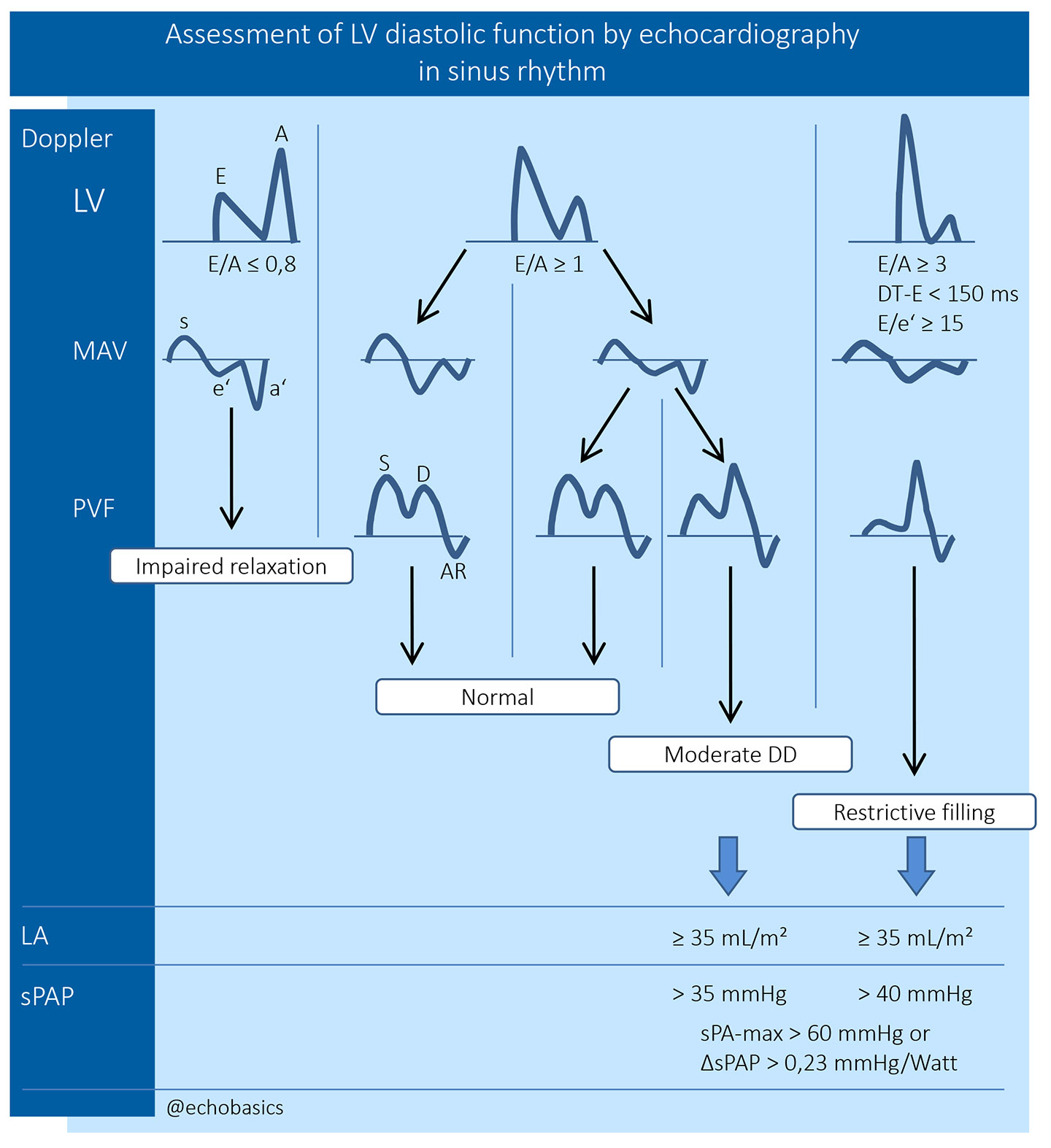
Algorithm for practical assessment of diastolic LV function
NYHA: New York Heart Association classification to stages of heart failure,
LV-EF: left ventricular ejection fraction, E/E':
relationship between maximal values of passive mitral inflow (E, PW-Doppler) and lateral early diastolic
mitral annular velocities (E', TDI),
LV-EDP: end-diastolic LV pressure, PASP:
pulmonary artery systolic pressure.