|
[start]
[author]
[print]
[impressum]
|
|
|
Echocardiography 5 minutes before starting

|
|
|
|
|
|
 Overview |
|
|
[Echocardiographic examinations]
[Transthoracic examination]
[TEE - views]
[Stress echocardiography]
[Contrast echocardiography]
[Cardiac asynchrony]
[Strain - Strain rate]
[3D | 4D echo]
[Indications for echocardiography]
[Training in echocardiography]
|
|
[Cardiac function and PA-pressure]
|
|
[Examples of pathological findings]
|
|
|
|
|
|

Cardiac asynchrony (dyssynchrony) |
|
|
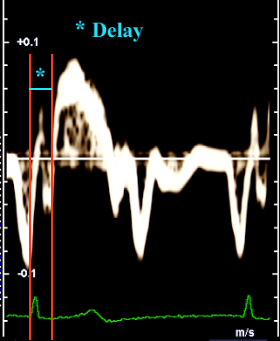
The different electromechanical delays are measured from QRS start to contraction start,but some times
they will be measured in a time-to-peak manner (QRS to maximal velocity), in cases of difficult TDI profiles.
ASE recommendations for performance and reporting:
echocardiography
for cardiac resynchronization therapy, 2008.
Assessment of RV and LV delays:
(using TDI, RV-free wall, LV septal basal, LV lateral basal, LV posterior basal)
Intraventricular asynchrony: LVsep - LVlat or LVsept - LVpost > 55 ms
Interventricular asynchrony: RVfw - LVsep > 70 ms or RVfw - LVlat > 55ms
Summ of asynchrony: LVas + RVas > 100 ms
Assessment of PET:
(pre-ejection time, PW-Doppler, RVOT and LVOT)
Intraventricular asynchrony: LVpet > 140 ms
Interventricular asynchrony: RVpet - LVpet > 40 ms

CRT optimization:
Definite echocardiographic parameters for CRT optimization are still not available.
VTI assessment at the
level of the LVOT, right underneath the aortic valve e.g., can give hints to acute changes in left ventricular
function, that may happen during manipulations in AV- and/or LV-RV-Delays and help in the decision
to
optimal CRT setting.
|
|
|
[overview]
|
|
|
|
|
|
|